
Yesterday I wrote about the importance of knowledge for reading comprehension. Today I wanted to share with you a hugely influential an useful model for all of the elements a reader needs.
Scarborough’s Reading Rope
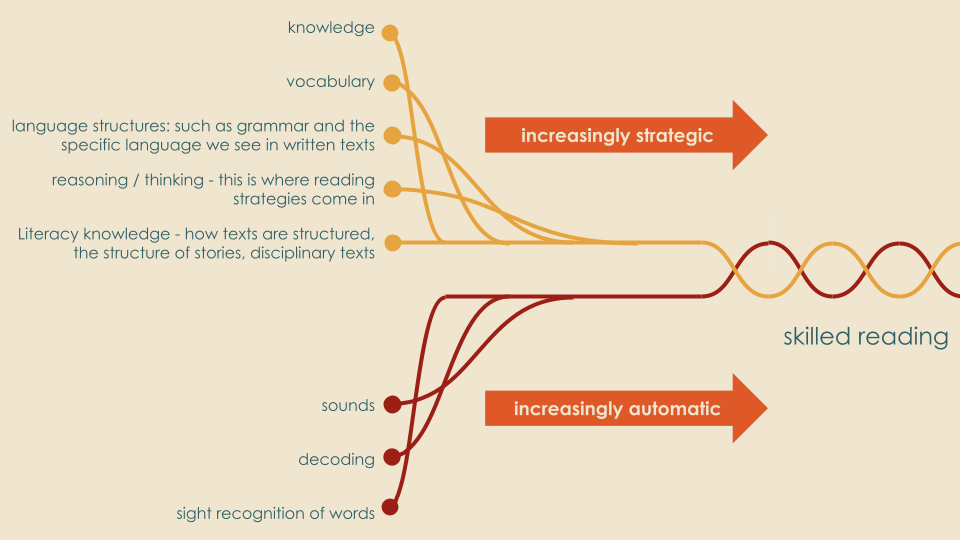
Dr Hollis Scarborough developed this rope model to explain to teachers the complexity of reading comprehension. Initially she used pipe cleaners to model it.
The bottom three strands of the rope are about decoding texts. Primary schools teach this part of the rope very well. Secondary colleagues, if your pupils are struggling to read, check this strand. Ask your feeder schools for support – they are likely to be packed with experts.
The top strands are about comprehension. I will discuss each strand below.
It’s also worth noting that a reader develops in the model by moving from left to right – as the reader can decode with greater accuracy and fluency and use the comprehension strands more strategically, they become better readers.
Knowledge and Vocabulary
I like to think about vocabulary not as individual words, but as a set of labels for ideas we want to talk about and write about.
Dr Gina Cervetti
Most books on reading focus more on vocabulary than on knowledge. This is a mistake.
Knowledge is coherent – that means ideas are linked together in meaningful ways, building complex understanding. Vocabulary is the labels for elements in the knowledge network. Both are important, but knowledge is rich and connected and leads to deeper comprehension and better understanding.
Readers get their knowledge about the world form many sources. Subject knowledge has the advantage of being well structured and complex, taught by someone with good knowledge themselves. Knowledge from other sources can be as rich, but is often piecemeal and is more likely to contain errors.
Knowledge learnt from books is also a great way to build deep and complex understanding. It’s worth remembering that readers who already have well developed background knowledge are the most effective at learning through reading.
One last point – you can’t start teaching children background knowledge abut the world around them too early. It’s worth spending as much time (more?) on knowledge building as on phonics.
Language Structures
We don’t speak the way we write, so readers need to understand the specifics of written language. This is likely to include subject specific styles of writing and phrases such as:
- ‘on the other hand….’;
- ‘the water is poured into the beaker’ and
- ‘Many Christians believe…‘
Close reading of the texts you read in class and tasks which encourage pupils to write using these structures will help readers develop this strand.
Reasoning
These are the comprehension strategies we spend a lot of class time trying to teach: making inferences; finding the main idea; summarising etc. In fact, we typically spend far too much time on these in class (see Willingham here).
… although it’s well worth the time to teach students comprehension strategies, there’s no reason to devote a lot of time to practicing them. A total of five or ten hours of instruction yields the same advantage as twenty or thirty hours.
Danie Willingham
Let’s say you tech your pupils various reading strategies in year 3 for a total of ten hours spread over a couple of weeks. They will make a leap forward in their comprehension. But it’s a one-time boost. Spending another ten hours causes no further leap. Instead, spend the reading time boosting knowledge and vocabulary from the books you are reading.
Literacy Knowledge
This knowledge is abut how texts work. What are the features of a story? How are science texts different from history texts? How does an index work? How do you interpret a diagram alongside a text (see my post here). Like the Language Structures strand, close reading and writing help readers develop this strand.
Strengths and Issues with the Scarborough Reading Rope Model
I love this model – I find it really helpful in understanding the complexity of reading. I like the way Scarborough put knowledge at the top, as though she knew it was the strand that was likely to be forgotten and wanted to draw attention to it.
My issue with the model is it doesn’t help us think about how much attention or class time to allocate to each strand. In particular, the reasoning strategies strand tends to get far too much attention in class. Instead, I would spend much more reading time pulling out the knowledge from the text and even explicitly teaching the knowledge (not just the vocabulary) readers will need to make sense of the text.
You can read Scarborough’s article here.
I hope that was useful – please comment or message me if you have any feedback.
Many thanks,
Ben

 Reading for Learning