
How can we ensure students understand complex scientific ideas, beyond just recalling facts? Developing their ability to write clear, precise sentences about science is a powerful, often overlooked, key to unlocking deeper comprehension.
Here is a simple technique to work with students to practise sentence building and therefore concept development. I adapted this from The Writing Revolution 2.0: A Guide to Advancing Thinking Through Writing in All Subjects and Grades by Judith C. Hochman , Natalie Wexler , et al. 2024 – a book I can’t recommend highly enough.
In my view, a visualiser is the best way to do this activity.
Start with the simplest possible version of a sentence (e.g. the green card below: it slowed down). Hochman et al call this the kernel sentence.
On up to three other cards, add additional information to add to the sentence. Typically, information which answers the classics: who, what, where, when, why or how. You might write these with your students, but I would start by preparing them before the lesson.
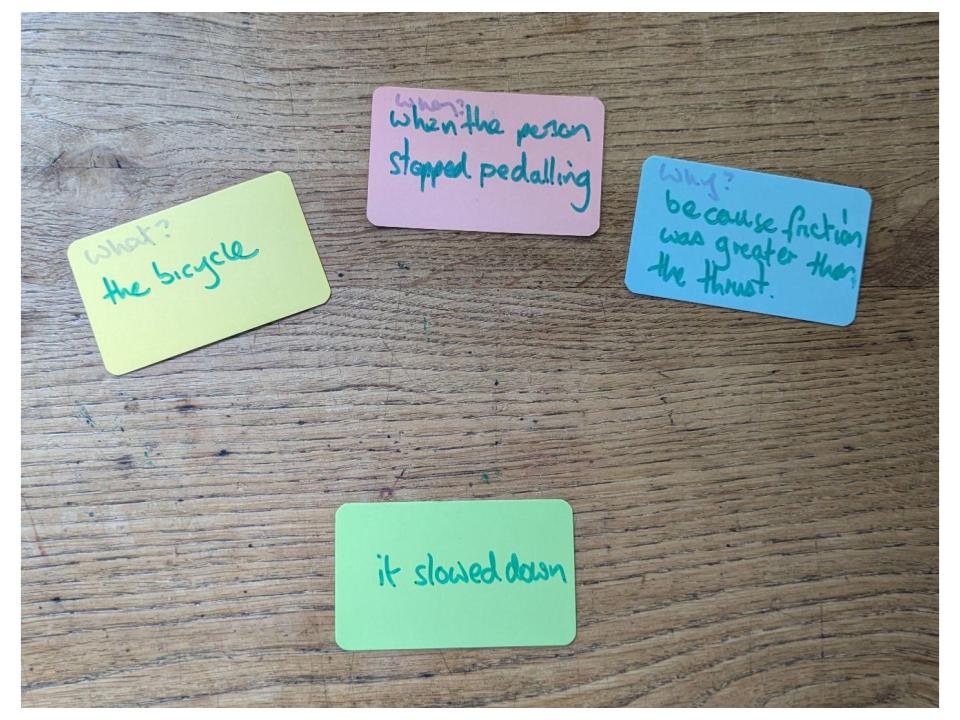
I usually start by replacing the subject of the sentence (who or what).
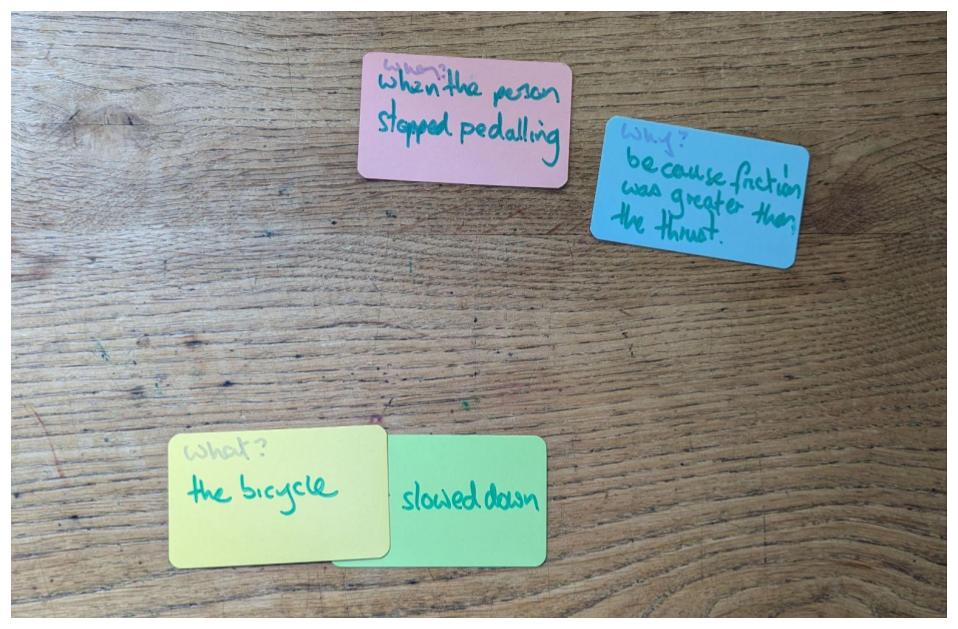
Then I add the other cards, showing the options. Read each arrangement aloud, showing that each version is possible.
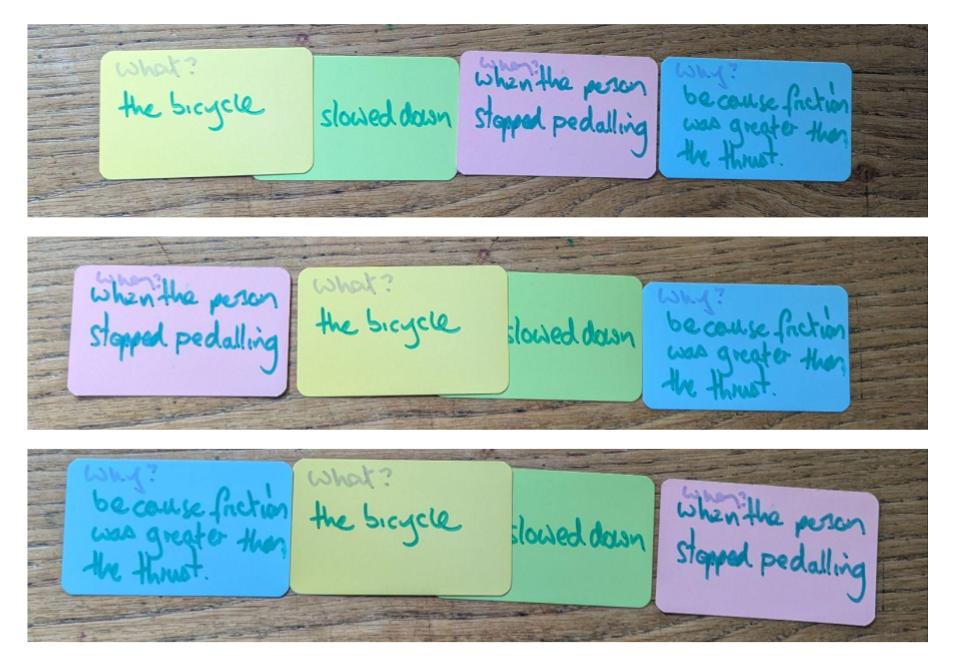
You can let your students choose the one they think is clearest. The choice typically depends on the context, but the big picture is that:
- it’s easy to build complex sentences and
- you have choices about the order.
Here is a 3 minute video of me using these cards.
Finally, it’s time to punctuate the sentences. The full stop and capital letter is easy. The commas are less straightforward:
- The bicycle slowed down when the person stopped pedaling because friction was greater than the thrust.
- When the person stopped pedaling, the bicycle slowed down because friction was greater than the thrust.
- Because friction was greater than the thrust, the bicycle slowed down when the person stopped pedaling.
I propose not worrying too much at this stage. Comma errors are not the worst thing in the world. I’d love it if everyone could use commas effectively, so maybe I’ll come back to that another day. For now, the most important thing is to explore these sentences with your students, to communicate more clearly and develop rich and connected concepts.
Ben

 Reading for Learning