
Yesterday, I published a blog showing how I teach longer sentences in science (here). The sentence examples I used were:
- The bicycle slowed down when the person stopped pedaling because the friction was greater than the thrust.
- When the person stopped pedaling, the bicycle slowed down because the friction was greater than the thrust.
- Because the friction was greater than the thrust, the bicycle slowed down when the person stopped pedaling.
I realised half way through writing that some science teacher colleagues might not be familiar with the grammatical rules for using commas. If a lack of comma confidence is stopping you from teaching your students to write in full sentences, this is the post for you!
There are three grammar terms you’ll need to understand commas.
Clauses: A clause is a part of a sentence. Each clause has a subject and a verb.

Independent Clause: This is a complete sentence. It has a subject and a verb and can stand alone.
- Example: The bicycle slowed down.
- Example: Friction was greater than the thrust.
- Subordinate Clause: This clause has a subject and a verb but cannot stand alone as a complete sentence. It relies on an independent clause to make sense. Dependent clauses often begin with subordinating conjunctions (like when, because, although, if, since, while) or relative pronouns (like who, which, that).
- Example: when the person stopped pedaling
- Example: because friction was greater than the thrust

2 Rules for Commas
The placement of commas depends on whether the dependent clause comes before or after the independent clause.
- Subordinate Clause at the Beginning of a Sentence:
- If a subordinate clause comes before an independent clause, you use a comma to separate them.
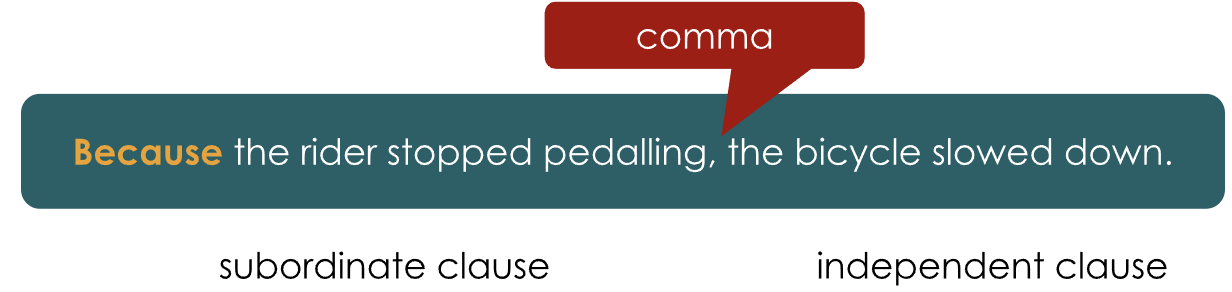
- Subordinate Clause at the End of a Sentence:
- If a dependent clause comes after an independent clause, you generally don’t use a comma.
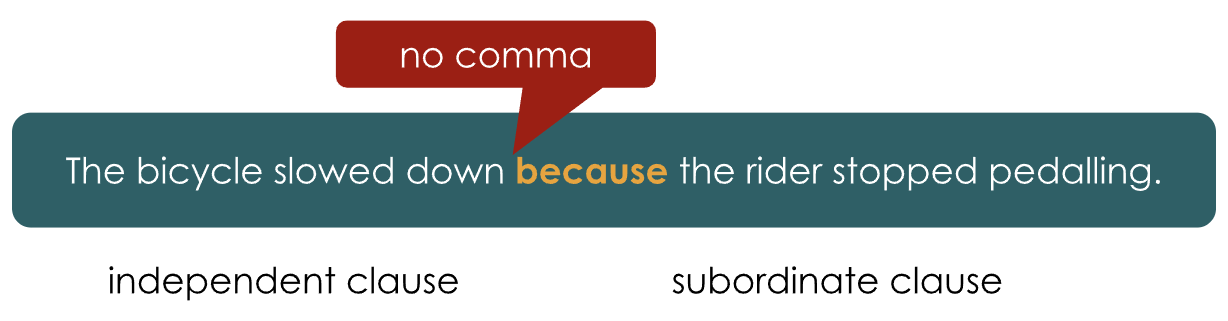
Multiple Clauses, Same Rules

In Short
You can see from the three examples above, you don’t need to put a comma if the conjunction separates the clauses – the reader knows the clauses are separate because of the conjunction. However, if the conjunction is not between the two clauses, but at the start of the sentence, the reader needs the comma to know the clauses are separate.

 Reading for Learning