

Summary
This blog shows how secondary teachers can use simple tools from the phonics teachers’ toolkit to support older students in mastering the language of physics.
Physics is a subject dense with Tier 3 vocabulary—words that are rarely heard in everyday conversation, possess precise scientific definitions, and often originate from Greek or Latin roots. For students in Key Stage 3, the cognitive load of decoding these words can overwhelm their working memory, leaving little room for understanding the actual scientific concept.
Physics Phonics is Challenging
No phonics programme teaches the word circuit, echo or vacuum. The letters used to represent the sounds in these words are really uncommon. It isn’t only weaker readers who will struggle with them.
The problem with physics spelling is that much of it derives from Latin and Greek. In Key Stage 1, we teach children “ch” as in “chip”. In physics it is often a “k” sound, like in “mechanics”. The ‘f’ sound in KS1 is usually “ph” in physics.
Other words (e.g. Celcius and Ohm) come from other languages.
Common Phonics Pitfalls in Physics:
- The /k/ sound: In early phonics, ch says /tʃ/ (as in chip). In Physics, ch almost always says /k/ (as in mechanics, chemistry, echo).
- The /f/ sound: Physics relies heavily on ph for the /f/ sound (physics, photon, phase), rather than f.
- The /sh/ sound: We see ti, si, and ci acting as /sh/ (motion, emission, special).
Dots and Dashes
The Concept: In primary phonics, we often put dots under single sounds and dashes under combined sounds (digraphs/trigraphs). We can use this technique for scientific terms on the whiteboard.
When introducing a new term (e.g. emission), do not just say it. Encode it.
Write the word clearly on the board – then use dots for the single letter sounds and dashes where the letters work together to make a sound.
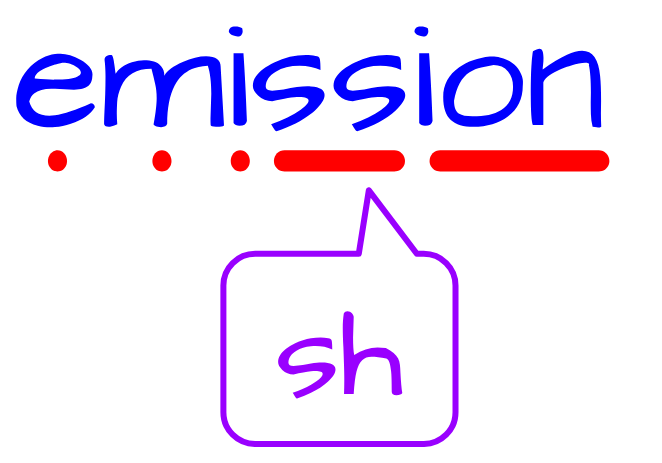
Segmenting
A similar strategy puts a slash between syllables – for example:

Say it Aloud: Choral Response
If a student cannot pronounce a word, they will struggle to read it silently, and they won’t use it in a written exam answer. Every student should practise saying the words aloud. Your year 7s will be used to it even if your older students are reluctant.

 Reading for Learning