
Some people don’t know much science, but it doesn’t seem to hold them back. Is there a limit to how little science you can get away with?
It depends on what you are trying to do. I’ve just read an interesting paper (here) which shows that below a threshold, if you don’t know enough science, you can’t comprehend a science text.
Background knowledge is key to successful reading comprehension (school reading leads take note). School subjects are key to good reading performance (famous Willingham video here).
The paper is great. There are two key things I want to share: the relationship between knowledge and comprehension and how to measure background knowledge really easily.
Reading Comprehension Depends on Background Knowledge
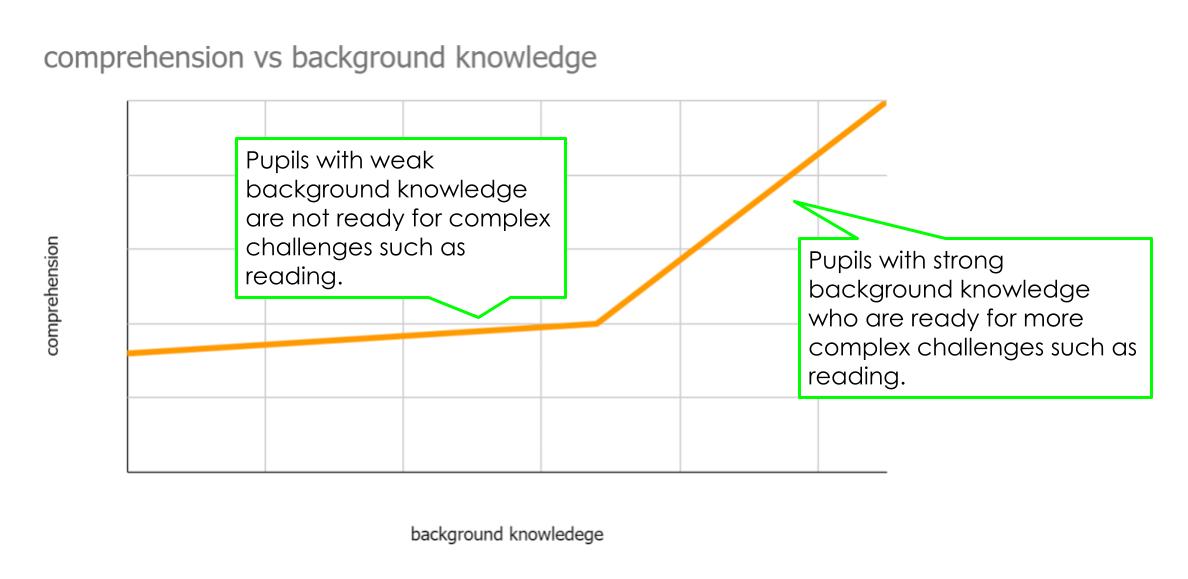
The authors measured background knowledge and then comprehension of a science text. They didn’t find a straight line correlation: it’s worse than that. They found a broken line.
Below a threshold, readers couldn’t comprehend much. Above the threshold, the more you know, the better you can comprehend.
Conclusion: don’t expect students to read and understand if they don’t have enough knowledge. But how can you check this?
How to Measure Background Knowledge Really Easily
The authors created a nice and simple assessment tool. Students just tick the words from a list which belong in the subject they are reading about.

A quick assessment of background knowledge
The authors found that using just 6 key words gave an accurate predictor of relevant subject knowledge. I think this works because pupils need a holistic understanding of a topic to know what key words are associated with it.
I’ve made a spreadsheet with example words to use in the assessment – you might want to edit these! (Other assessment resources are available – here’s a Visible Learning one).
Extra Note
In science, we often try to do complex (interesting) things before our pupils have sufficient background knowledge – for example:
- reading;
- writing;
- discussion;
- problem solving and
- enquiry.
Extra Extra Note
To teach background knowledge, we’re not talking about lecture-style or rote learning. We’re talking Rosenshine’s Principles and explicit teaching.
Reference
O’Reilly, Tenaha & Wang, Zuowei & Sabatini, John. (2019). How Much Knowledge Is Too Little? When a Lack of Knowledge Becomes a Barrier to Comprehension. Psychological Science. 30. 1344-1351. 10.1177/0956797619862276.

 Reading for Learning
2 Comments