
Clue: it all depends on your background knowledge.
I think we all agree don’t we? Reading is the most important thing we teach in schools.
I’m going to assume we all agree: teaching reading is the most important thing we do in schools. In this post, my aim to is share how cognitive science understands reading comprehension.
As part of your reading or teacher training, you re likely to have come across Scarborough’s Reading Rope model. If not, it’s worth a look (here).
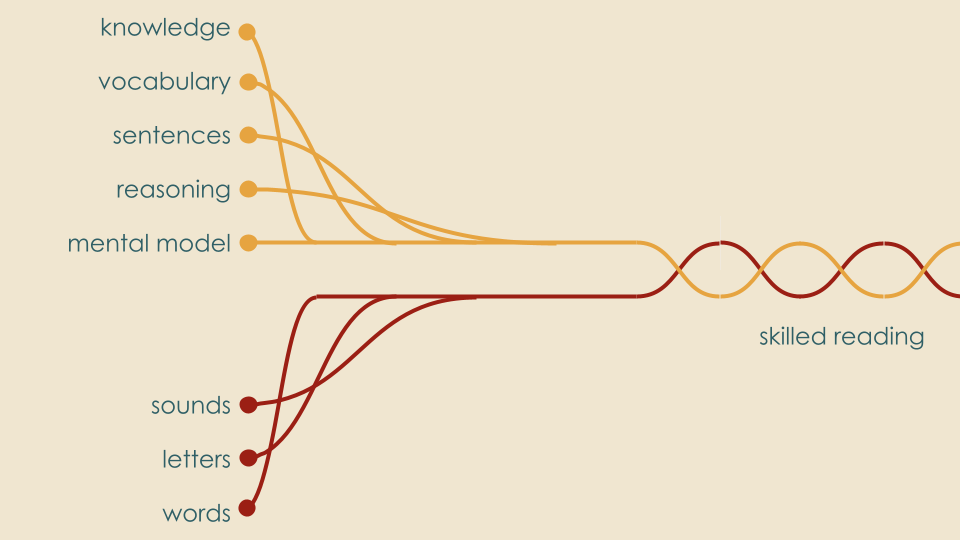
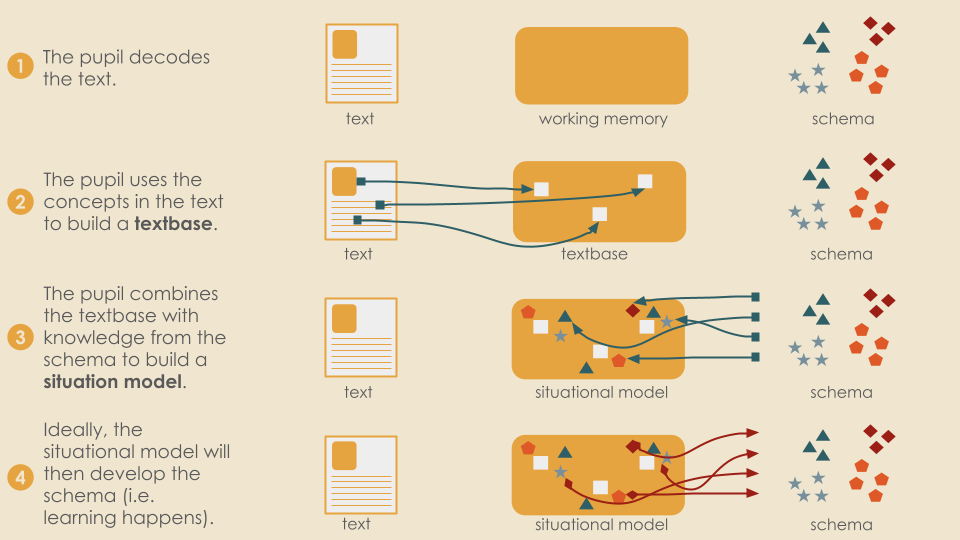
Once a person can decode accurately and with fluency, the biggest comprehension gains come from improved background knowledge. But how does background knowledge support reading comprehension?
Stage #1 – the reader decodes the text
As long as the reader can decode accurately and with fluency, the brain can start to work on the meaning.

Stage #2 – the reader builds a textbase

The textbase is the information the reader infers straight from the text. On its own, the textbase is not so helpful – the author has not written in every detail because the reader already knows a lot of that information. For example:
| What the author writes | The Textbase | What the author probably means |
| It was a winter’s day and Sameera trudged slowly to school. | day; winter; Sameera; slowly trudge; to school. | The weather was probably cold; there may be snow. Sameera (a person) isn’t keen to go to school. School is a place where children and young people go to learn. |
When a pupil doesn’t have enough background knowledge, all they get is the textbase.
Stage #3 – the reader adds background knowledge from their schema.

The situational model is the key to comprehension: it’s the textbase supplemented by the rich (or not so rich) contents of the reader’s schema. The richer the schema, the deeper and richer the comprehension. This is why background knowledge is so important to reading comprehension.
Each reader has different background knowledge, which means we all comprehend a text differently. If a reader who had only lived in Africa read the text about Samira trudging to school on a winter’s day, they would build a different situational model than a reader from Scotland. A person with a metrology degree would read it differently again, as would a school child who has been bullied at school.
All of these different situational models, some rich with detail, others impoverished, are all the result of reading the same text.
Teachers have two main task to do here:
- test each pupils situational model for accuracy as well as richness. You want to know where the gaps and where the errors are (e.g. How is Samira feeling? What do you think the weather is like? What might she be wearing?
- develop each pupil’s background knowledge so that they have a better chance of creating a rich situational model. A big part of this is will come from subjects, but also school visits and experiences; conversations in corridors and last, but definitely not least, from reading itself.
Stage #4 Ideally the reader learns something

Comprehension is not the end goal – learning is. Ideally, the reader will use their situational knowledge to develop their background knowledge. A skilled or highly motivated reader will probably do this for themselves (dinosaurs anyone?) Otherwise, you are going to need to help, usually by asking questions.
Thanks
I hope that’s useful. I’d welcome feedback as I hope to use this model in teacher training this year. I wonder whether I’ve used too much jargon, or assumed to much background knowledge (ironically!) Please let me know.
Thanks,
Ben

 Reading for Learning
I think it is a clear explanation that shows the importance of discussing reading, especially with novice readers, to help them develop their ideas and understanding of stages 2 and 3 so that they can eventually use these skills independently.
I am going to use the text base with my class.
There isn’t too much jargon and I assume there will be pre-teaching of the key vocabulary and reading to do before hand so the students should find it interesting.
Thanks for all the thought provoking blogs.
LikeLike
Thanks 🙂
LikeLike