
One of the great pleasures in physics teaching is telling stories. But who is the world greatest physics storyteller? I believe it is my friend and colleague Richard Brock, the doyen of physics storytelling.
We met in February 2020 at a Institute of Physics event. I was Richard’s warm-up act. My job was to explain how I thought that stories were mentally ‘sticky’ and how telling physics ought to help our students remember their physics concepts more easily. But I had a word of warning: are the stories seductive – distracting the mind away from the actual content? Would we discover in the years to come that our students remember the stories, but not the physics?
On that bombshell, I said, “…and now, over to Richard!”
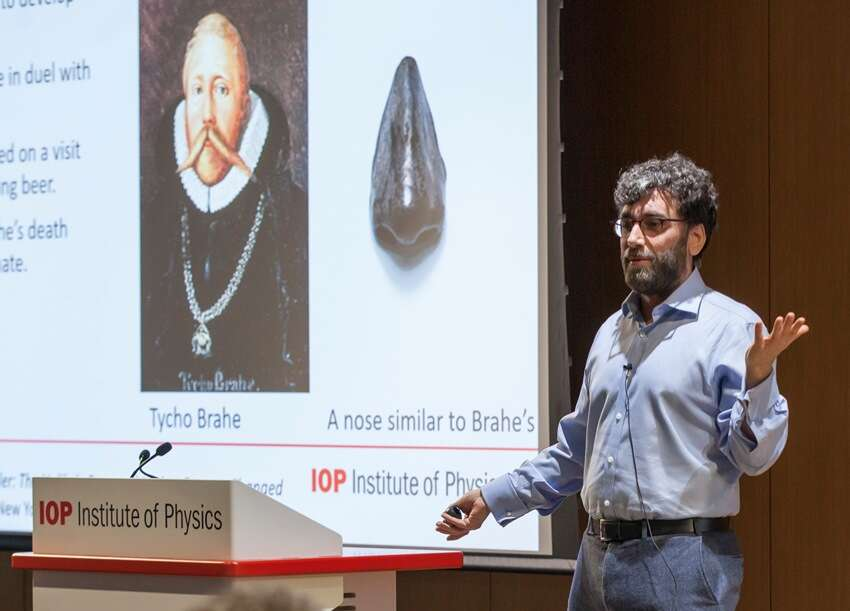
Richard with “a nose similar to Tycho Brahe’s”
Over a glass of wine afterwards, Richard and I speculated on the possibility of how we’d test whether stories helped or hindered content retrieval and application. Five years later, working with Liam Cini-O’Dwyer at Kings College London, with support from the Institute of Physics, here it is: The Effect of Seductive Details on Knowledge Retention in Physics Videos: A Mixed Methods Study (Brock et al, 2025).
Obviously, you’ll want to read it yourself, but (spoiler alert) here’s what we found:
Sadly, seductive details, such as stories, will typically be detrimental to learning core content. However, the negative impact can be mitigated.
We suggest three way that the negative impact of stories might be minimised:
- increased student interest,
- chunking, and
- providing anchoring in the case of low prior knowledge.
So, if you’re a keen storyteller in your science lessons, think about choosing your stories with care to align closely with the content and keeping them short.
Many thanks to Richard and Liam and for the support of the IoP.
Brock, R., Cini O’Dwyer, L., & Rogers, B. (2025). The Effect of Seductive Details on Knowledge Retention in Physics Videos: A Mixed Methods Study. Journal of Research in Science Teaching, 1-18. Advance online publication. https://doi.org/10.1002/tea.70005

 Reading for Learning