
This blog is about the forgotten half of oracy: not talking but listening.
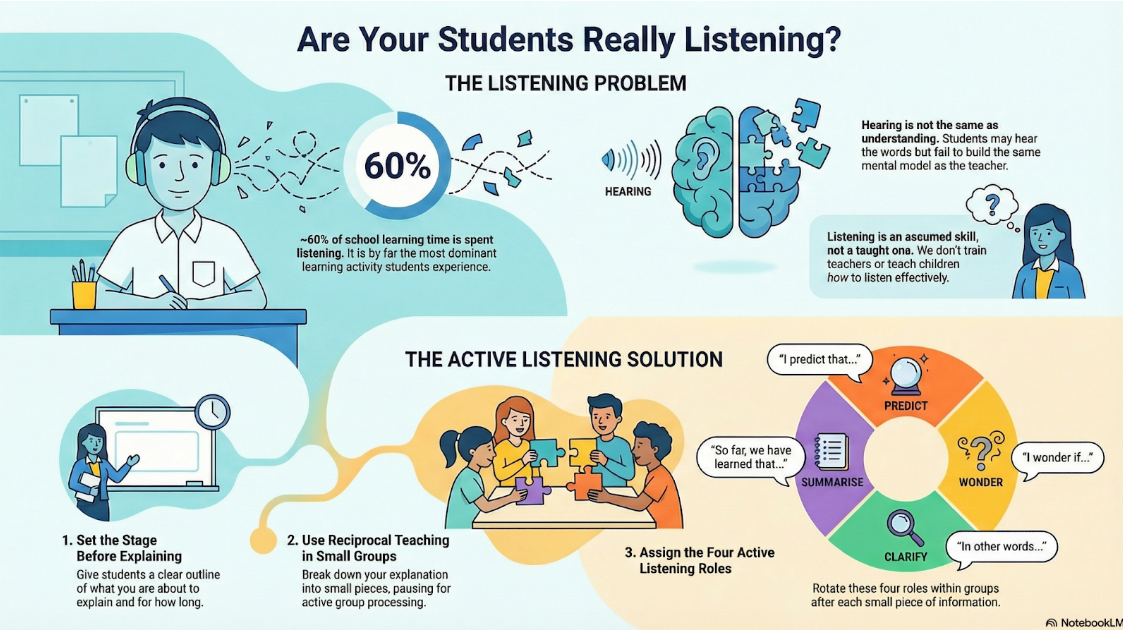
Listening is often described as the Cinderella literacy skill: it does all of the work in the background, but never goes to the ball. Depending on the study, the age group and the subject, students spend around 50% of their school time listening – but we never teach effective listening skills. It’s a good job we’re born to listen.
Apparently babies listen from inside the womb. They begin the long task of making sense of the world apparently from 24 weeks. Perhaps we don’t need to teach it?
Classroom experience suggests we do. Just ask a class to follow a simple instruction – for example Leave 10 lines and write the date. What proportion of your class will get that right? Listening is far more effortful and skilful than it sounds (just ask a speech and language therapist or your SENDCO).
Recent evidence suggests that, particularly since lockdown and the rise of mobile phones, our listening comprehension skills are getting worse. Even when they understand every word being spoken, our students are often unable to build the same mental model that we are attempting to convey. The following techniques are supported by Speech and Language as well as educational research.
Strategies for Active Listening
To address this challenge, strategies derived from speech and language research are highly applicable, not just for children with additional needs, but for all students and adults.
1. The Pre-Explain: One recommendation from Speech and Language practice is to provide listeners with an outline of what they are about to hear, often referred to as a “pre-explain” or “pre-teach”. This means first stating the objective (e.g., “I am going to explain how the angles in this triangle add up”) before starting the detailed explanation.
2. Harnessing the Power of Talk: A spoken explanation and a written one are different. Spoken explanations are often improvised: the quality of the “text” is grammatically lower than carefully edited written material. However the spoken word is supported by gestures, diagrams, physical objects and interactive questioning. The speaker can check for comprehension and adjust the explanation on the fly. This more than compensates for the lower quality of the words.
So it is vital for your students to direct their attention to you as you speak. The Teach Like a Champion strategy of SLANT (sit up, listen, ask and answer, nod and track the speaker) helps your students comprehend the complicated explanation you are delivering.
3. Reciprocal Teaching for Active Engagement: A very powerful strategy, well aligned with instructional principles like Rosenshine (breaking new content into small pieces, asking questions, guided practice etc.), is Reciprocal Teaching. This approach gives listeners four defined roles and forces them to break down the explanation into smaller, manageable pieces.
When introducing new content, the teacher explains a small part of the concept. The group (ideally four students) then uses these assigned roles:
| Role / Sentence Starter | Action |
| I predict | Anticipates the outcome or possibility |
| I wonder | Poses a related question or doubt |
| In other words | Summarises the core content |
| So far | Summarises the explanation so far |
This technique encourages a much more engaged process known as active listening. These same reciprocal teaching strategies are effective when applied to reading comprehension, where pupils use the roles to process smaller paragraphs of text.

 Reading for Learning