
Morning – just a quick post on using a fishbone diagram to help students write more focused cause and effect … More
Author: BenRogers
18 years secondary teacher: 4 years primary. MA in SciEd. Author of 'Big Ideas of Physics and How to Teach Them.' Director of Curriculum and Pedagogy for Paradigm Trust.
The Under-Governed Classroom
Competitive Control in The Classroom Back in April 2008, I left a well-managed, highly successful secondary school in East London. … More
Visible Physics – My ASE Presentation
Many thanks to everyone who came. I really enjoyed it and am grateful to colleagues who chose to come. I … More
Using Multiple Choice Questions to Assess High-Level Thinking in Science
We are very good at assessing retrieval through multiple choice questions (MCQs): they are easy to write and quick to … More
It’s Hand-Wavy, But in a Good Way
In class, I’m mostly watching hands. There’s a problem I like to set which gets people’s hands waving like windmills. … More
ResearchEd Ipswich Presentation
I’m really excited to be presenting at ResearchEd Ipswich next weekend. I’m talking about the power of visuals in science … More
Developing better diagrams for problem solving
This post about an approach to developing better diagrams for problem solving from Barbara Tversky’s book: Minds in Motion. I’ve … More
Why Gestures are Important
This post summarises the findings of a paper by Barbara Tversky: Gestures for Thinking and Explaining (2005). The author demonstrates … More
Cartoons and Abstract Visuals
Barbara Tversky (Minds in Motion) discusses the cognitive power of cartoons to explain abstract concepts. In these three images, I … More
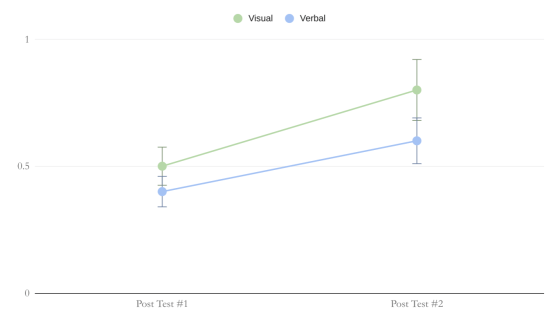
Using Visual Explanations Leads to Better Performance
I have been listening to Barbara Tversky’s wonderful new book: Mind in Motion, about the roots of thinking in the … More
 Reading for Learning