
Energy is not in the KS2 science National Curriculum and is not likely to be introduced following the review. This is a mistake. Pupils picking up misconceptions about energy every day.
Energy is a mysterious and abstract concept, but it is also an everyday word. This is the sweet spot for misconception creation.
This article argues for teaching of energy in primary science and suggests how it can be taught without introducing misconceptions.
Question: What Is Energy?
Answer: no one knows. According to Richard Feynman
“”It is important to realize that in physics today, we have no knowledge of what energy is.” Feynman (1963)
But it’s still an incredibly useful concept in physics. Money in your pocket is a useful comparison. You don’t have to understand it for it to be useful.
Does having money make you buy something? No – the money in your pocket only determines whether you can buy it or not.
Energy behaves the same way. Storing energy in your car doesn’t make the car move – the available energy just tells you whether driving is possible.
According to Charles Tracy of the Institute of Physics:
- Energy Analysis is about calculations;
- Energy discussions are prone to explaining away the interesting, beautiful and revealing process and mechanisms that make things happen.
Explain the Beautiful, Revealing Processes First
Tracey is right. We often use energy to wave away explanations. How do our muscles work? Energy. How does the light work? Energy. This misses the beautiful explanatory power o physics.
So instead of using energy to explain anything, use physics. These examples are taken from from Tracy and my chapter in the book Primary Science in a Nutshell (Hoath and Rogers 2025).
| If someone says… | You could say… | Comment |
|---|---|---|
| Sports drinks give you energy. | Sports drinks provide your muscles with the sugars they need to move. | The original sentence suggests energy is a substance. Better to rephrase using actual substances. |
| The leaves absorb energy from the sun. | The leaves absorb sunlight. | The original sentence also suggests that energy is a substance. In the adapted sentence, the leaf is absorbing light. |
| Wind turbines generate energy. | Wind turbines use the wind to generate electricity. | Words such as ‘generate’ suggest to pupils that energy can be made. Better to say what is actually being generated – electricity. |
| Your muscles use up energy when you run. | Your muscles use up sugar and oxygen when you run. | Phrases such as ‘use up’ suggest to pupils that energy can be destroyed. Better to say what is actually being used up. |
From Primary Science in a Nutshell
Misconceptions
Teaching scientific concepts early can reduce misconceptions later on. See Novak (2005)
The main argument I have heard against teaching energy at KS2 is that primary teachers may introduce misconceptions. In my view, the opposite is true. Because pupils hear the word energy every day, the misconceptions build up. By secondary school, the misconceptions are firmly embedded. Novak used longitudinal data to show that teaching science concepts (instructed) early reduces misconceptions years later. Embedded misconceptions are very difficult to shift later on.
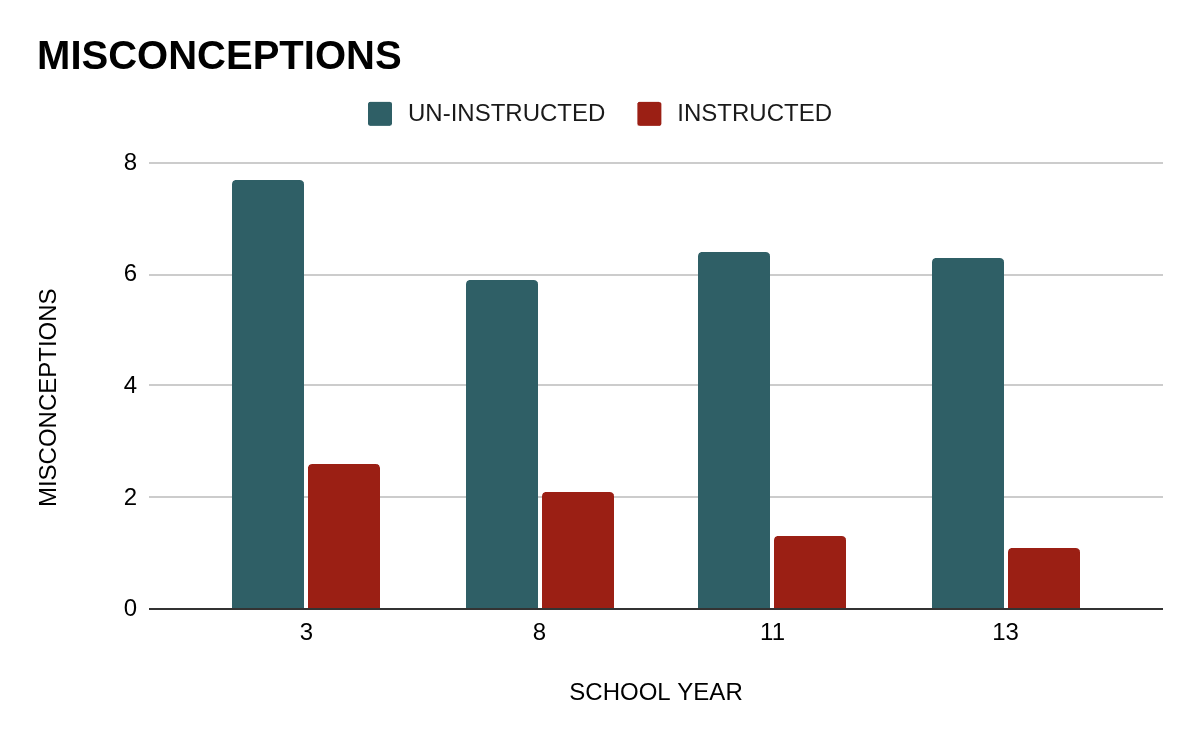
Novak 2005
The Institute of Physics has produced an educational model of energy to reduce the introduction of misconceptions. It is designed for Key Stage 3, but can easily be adapted and simplified for Key Stage 2 without causing more misconceptions. The model uses Energy Stores to explain how energy is distributed and conserved.
Which Energy Stores Are Appropriate for Key Stage 2?
I have selected five of the Institute of Physics’ Energy Stores for the Key Stage 2 science curriculum. These tie in neatly
Chemical Store
Chemical stores include:
- Fuels (e.g. petrol, coal etc)
- Calorific foods (e.g. sugar and fats)
- Batteries
Kinetic Store
Any moving object is a kinetic store. A moving car; a running person; a molecule of oxygen.
Gravitational Store
This is more abstract. Any object which has the possibility of moving up or down is a store for energy.
Elastic Store
Think catapults, bows and anything you wind up. The bent or twisted material is an energy store.
Thermal Store
The energy stored when an object’s temperature is increased.
Note: I haven’t included an electrical store, because electricity isn’t stored.
Calculations
Primary pupils and teachers have the perfect tool for calculating energy: the bar model.
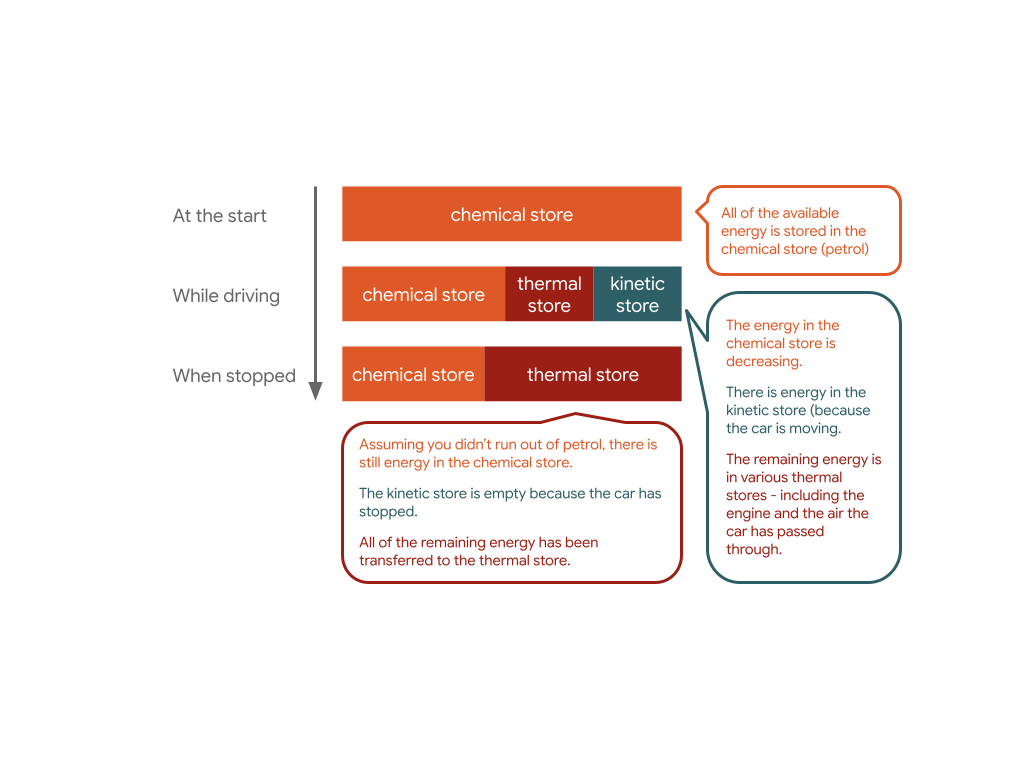
- The bars make it obvious that energy is conserved – the bars are all the same length.
- There is no need to use numbers – but you can if you want.
Conclusion
Can energy be safely taught in primary school? Yes. Pupils and teachers can follow the simple energy stores and bar models to calculate energy transfers with minimal risk of introducing misconceptions.
Should energy be taught at primary school? Yes. By teaching this concept early, we can inoculate pupils against later misconceptions.
Ben

 Reading for Learning