
If you can’t write it, you can’t think it.
The science and humanities curricula are full and there just isn’t time to teach grammar. That’s only partially true. Science and humanities teachers need to make time to practise just two types of sentences:
- Sentences which link two ideas to add meaning and
- Sentences which add rich detail.
These two sentence types both practise the grammar that students need to preform well and they help students enrich the knowledge you have taught them.
I have split this post into 2 to cover each sentence types in enough detail.
Part#1 Linking Ideas to Add Meaning
Look at the difference between the sentences a passing student writes and one who is working towards the expected standard. Typically, students working towards the expected level don’t write effective sentences.
There are really just 2 sentence types you need to practice with your students. The first looks like this:
- One thing happens because another thing happens.
- One thing happens so another thing happens.
- One thing happens when another thing happens.
These are called complex sentences, but they aren’t really complex. They are just 2 simple sentences (often just a noun and a verb) joined with a connecting word (a conjunction).
These sentences are powerful in subjects because they show how the two ideas are linked (note: ’and’ is the most commonly used conjunction, but it doesn’t tell you how the ideas are linked. Weaker students use ‘and’ when they could be using other conjunctions).
One more fact about these conjunctions: you can swap the order. E.g.
- Because the Pope would not dissolve his marriage, Henry broke with Rome.
- Henry broke with Rome because the Pope would not dissolve his marriage.
A list of useful conjunctions include:
| Relationship / Category | Conjunctions | Example |
|---|---|---|
| Time | After, As, Before, Once, Since, Until, When, Whenever, While | Science: The particles speed up when you heat the water. History: Harold’s troops were exhausted after marching from Stamford Bridge to Hastings. |
| Cause & Effect | As, Because, In order to, Since, So that | Science: Thermal decomposition takes place because the bonds are broken. History: Henry broke with Rome because the Pope would not dissolve his marriage. |
| Condition | Although, Even if, Even though, If, Unless, Whether | Science: The water in a pressure cooker doesn’t evaporate even though it is hotter than 100oC. History: Although working men had many more rights than women, most were still not allowed to vote. |
| Contrast & Concession | Although, Even though, Whereas, While | History: Although Henry was deeply religious, he broke with Rome. Geography: Although cities can be expensive, many poor people move there to look for work. |
| Place & Manner (how something behaves) | As, As if, As though, Where, Wherever | Science: As the temperature increases, the speed of the particles increases. History: Where poverty was greatest, discontent grew. |
How to Teach These Complex Sentences
The Classic: But, Because, So
This technique was popularised by Judith Hochman in The Writing Revolution. Take a simple sentence starter (the kernel) and add three different conjunctions. Hockman uses but, because and so but you should pick three which do specific tasks in your subject. E.g.
Coastal erosion happens when… (e.g. waves erode soft rocks.)
Coastal erosion happens although… (e.g. it isn’t even around the coast.)
Coastal erosion happens so… (e.g. homes may get destroyed.)
Sentence Building
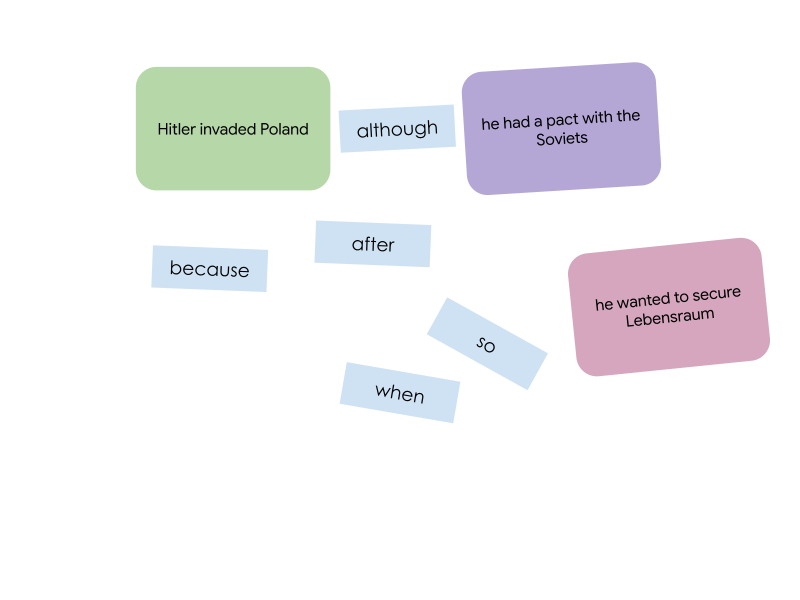
Give students simple sentences on cards together with a selection of conjunctions on smaller cards. Students construct as many meaningful sentences as possible.
The Benefits of Working on Complex Sentences
When you work on sentencers, you are doing at least two beneficial things. You are practising useful writing skills which will help your students perform better in assessments.
You are also building connections between simple facts. Typical retrieval practice only reinforces the simple facts: sentence building links those facts into a rich and connected schema.
I will post Part#2 Sentences which add rich detail later in the week.
Ben


