
Series: Teaching Physics Calculations to Dyscalculic Students| Read time: 3 minutes
Posts in this series:
- Introduction: Dyscalculia in Physics
- Part1: Variables
- Part2: Using Bar-Models to show Conservation
- Part3: Using Bar-Models to Teach Rate Calculations
The Problem: “What happens if the mass of the trolley is doubled?“
Dyscalculic students struggle to picture how changing one variable changes another. Formula triangles don’t help.
The Solution: The Area Model
Instead of treating F, m and a as abstract symbols in the formula F=ma, treat the total product (Force) as the area of a rectangle.
E.g. The whole rectangle below represents a trolley of 4kg (x-axis) accelerating at 3m/s2 (y-axis). Counting the tiles shows that 12N is needed (12 cards).
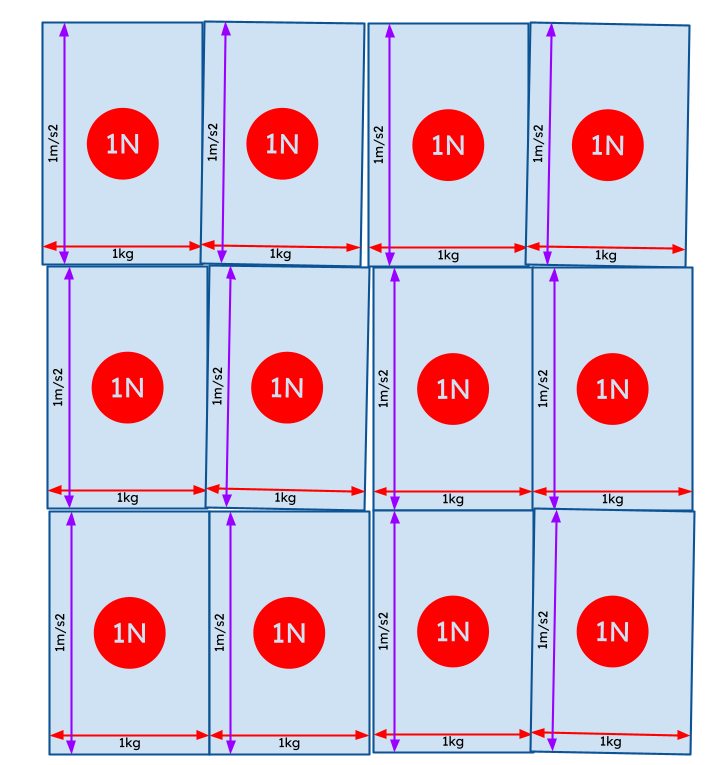
Question: If you halved the mass but kept the force the same, what would the acceleration be?
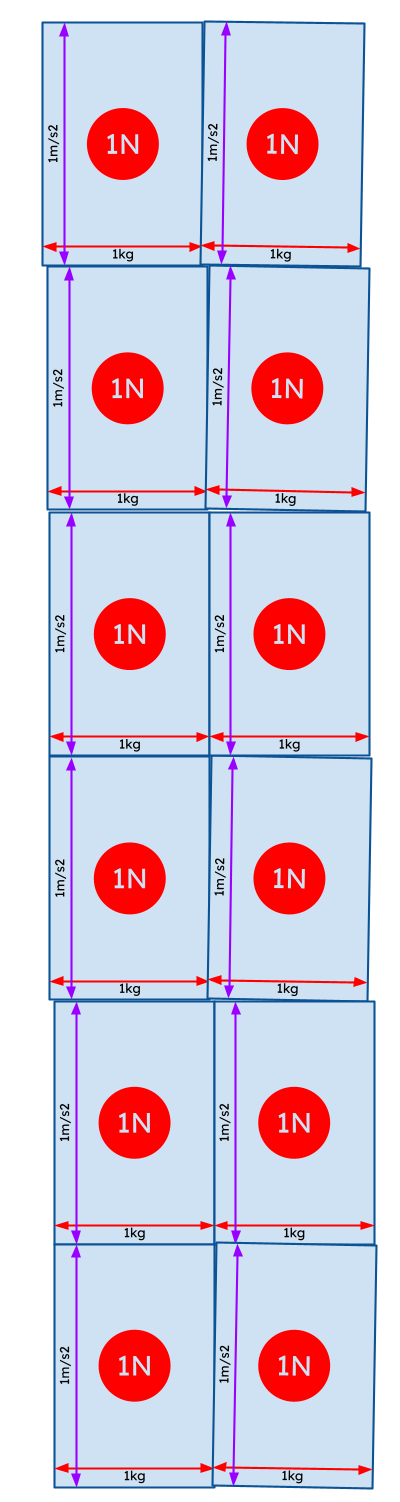
Answer: You have the same number of cards (12N) but the number of cards across the x-axis has halved. Therefor the acceleration increases (doubles) to 6m/s2.
This representation powerfully shows a student why the acceleration has to double in order to keep the overall force the same. It reveals the relationship more visually than a formula can.
Classroom Routine: From Visualiser to Mini Whiteboard
1. The 2-Minute I Do
Start under the visualiser with a single 3 x 4 grid of cards representing 12N of force.
- Ask: “What if we double the mass to 6kg without changing the 12N of force?”
- Under the camera, rearrange the cards.
- Pupils instantly see that doubling the width forces the height to halve. Inverse proportion is no longer an abstract rule.
2. Student Card Exploration (Keep It Simple)
Provide pairs of students with 12 cards and set them simple F=ma questions. You can check for understanding quickly by scanning their grids of cards.
3. Transition to Squared Paper (The Portable Exam Tool)
Once pupils get the concept, ditch the cards. Pupils sketch rough rectangles on grid paper or whiteboards:
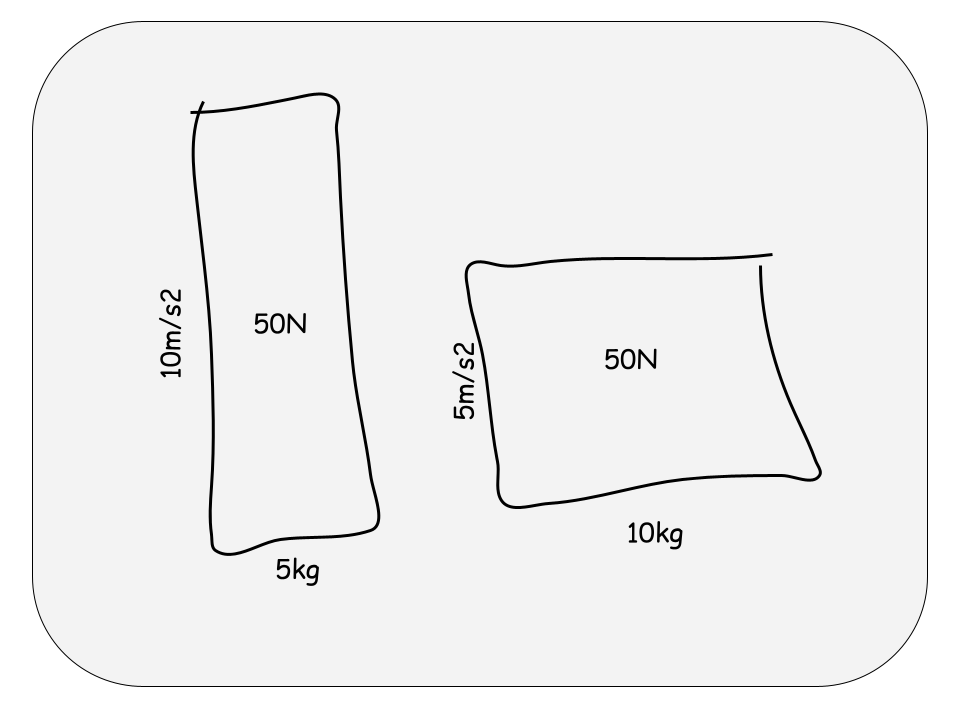
- Draw a tall, narrow box for small mass / high acceleration.
- Flatten the box outwards for large mass / low acceleration.
Other Formulae
This works with any formula in the form of A = B x C For example:
- momentum = mass x velocity
- charge = current x time
- potential difference = current x resistance
- mass = density x volume


