
Series: Inclusive Physics Teaching (Part 3 of 5)
Read time: 3 minutes
Posts in this series:
- Introduction: Dyscalculia in Physics
- Part1: Variables
- Part2: Using Bar-Models to show Conservation
The Problem: Rates in Physics Are Difficult to Visualise
Many physics students struggle with equations involving rates—like speed (v = d/t), acceleration (a=🛆/t), power (P = E/t), and current (I = Q/t). Students with dyscalculia find this especially difficult.
When dyscalculic learners see these fractions, they frequently experience cognitive overload. Formula triangles offer a quick calculation fix, but they mask what a rate actually is. Students end up pressing calculator buttons blindly without realizing that a rate is simply an amount accumulated every second.
The Solution: 1-Second Cards
Instead of jumping straight to abstract arithmetic, make rates physical and visual. Use card cut-outs representing 1 second of motion, energy transfer, or charge flow.
How It Works
- Define the Card: A speed of 5 m/s means a 1-second card is worth 5 metres. A power of 25 W means a 1-second card transfers 25 Joules. A current of 3 A means 3 Coulombs pass every second.
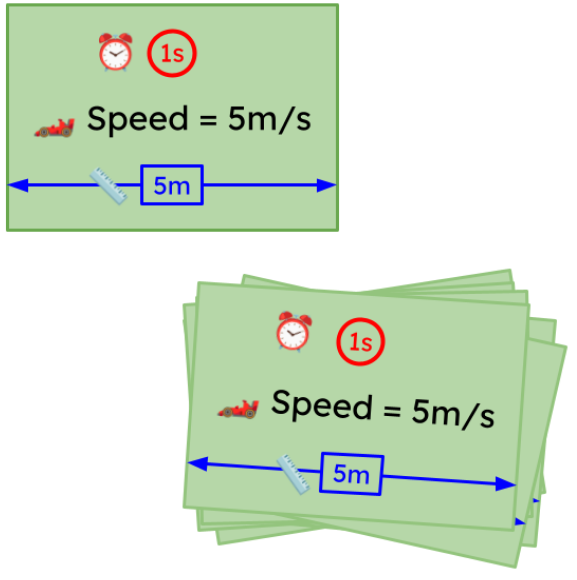
- Stack for Multiplication: To find how far a cyclist travels in 15 seconds at 5 m/s, place 15 cards side-by-side.

- Count and Calculate: The physical length of the combined cards reveals the total distance (15 × 5 m = 75 m).
Flipping the Problem: Finding Time
Rate cards also eliminate algebraic confusion when solving for time.
- The Challenge: “How long will it take for 15 C of charge to pass at a current of 3 A?”
- The Action: Lay down cards one by one, giving each 3 C, until you reach the target total of 15 C.

- The Result: Count the cards (5 cards) to find the time (5 seconds).
Key Stage & Tier Progression
| Stage / Tier | Pedagogical Approach | Implementation |
|---|---|---|
| KS3 | Physical Manipulatives | Use physical printed unit-rate cards so pupils physically lay down and count seconds to solve rate word problems. |
| GCSE Foundation & Higher | Abstract Representations | Transition from physical cards to quick sketch-bar models on paper, maintaining the same 1-second part-whole logic. |
Busy Teacher Takeaway
Don’t rush students into rearranging algebraic fractions. For rate equations, let them build the total quantity card-by-card first. Once their hands and eyes understand that time stacks the rate, algebra simply becomes a record of what they can already see.


