
Series: Inclusive Physics Teaching (Part 1 of 5)
Read time: 3 minutes
Introduction to the Series: Supporting Dyscalculic Learners in Secondary Physics
The Problem: Linking Symbols to Meanings
When a dyscalculic student stares at a physics calculation, the initial bottleneck isn’t the arithmetic: it is the student’s ability to map a symbol to a value.
Dyscalculia impairs the brain’s ability to map abstract characters to physical meanings. While a physics teacher sees V and instantly thinks “potential difference,” a dyscalculic student sees an arbitrary letter that consumes limited working memory.
This frequently leads to symbol swap errors – for example:
- Writing A for current instead of I (confusing the variable with the unit Amps).
- Mistaking V for velocity instead of potential difference (or thinking V in V = IR is just the unit Volts).
If a student exhausts their cognitive bandwidth decoding symbols, they have no working memory left to solve the equation.
A Strategy: The Three-Part Variable Box
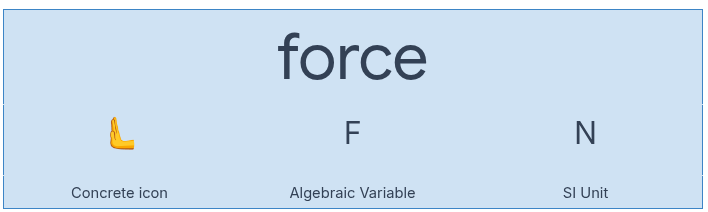
Instead of replacing variables, we display them inside a Three-Part Variable Box. Whether drawn on the whiteboard, printed in a knowledge organiser, or placed in the margin of a worksheet, every quantity is presented with three linked components:
| Physical Quantity | 1. Visual Icon (Concrete) | 2. Variable Symbol (Abstract) | 3. SI Unit (Measurement) |
|---|---|---|---|
| Force | 🫷 | F | N (Newtons) |
| Mass | ⚖️ | m | kg (Kilograms) |
| Acceleration | 🏎️ | a | m/s² |
| Current | 🌊 | I | A (Amperes) |
| Potential Diff. | 🔋 | V | V (Volts) |
| Resistance | 🚧 | R | Ω (Ohms) |
Classroom Action: The 3-Step Annotation Method
Teach students this low-friction routine when decoding word problems:
- Step 1 (Icon): Draw the icon over key terms in the question (e.g., a tiny 🚧 over “resistance”).
- Step 2 (Variable Pair): Write the algebraic letter next to the given number (R = 5 Ω).
- Step 3 (Equation Selection): Match the identified variables to the equation bank.
Key Takeaway: Linking the abstract letter I with both a visual flow icon and its unit A creates three distinct retrieval pathways in working memory instead of one, eliminating variable-unit confusion.
Key Stage & Tier Progression
- KS3 & GCSE Foundation: Heavy explicit use of all three components (Icon + Variable + Unit) on slides and worksheets.
- GCSE Higher & A-Level: Gradually fade the concrete icon while preserving the visual separation between the algebraic variable (I) and the SI unit (A).
Next Up
In Part 2, we examine why formula triangles fail dyscalculic learners and how to implement Multiplicative Bar Models for F = ma, V = IR, and W = mg.
How do you currently help students distinguish variables from units in your classroom? Let’s discuss in the comments below.


1 Comment